An ASO competitor data API lets you pull rival apps' keyword positions, metadata and related estimates into your own tools, but the numbers differ by provider. One documents its position as Search API order, not native App Store rank, so read each definition before comparing.
This article covers what these APIs return and where providers differ on rankings, estimates and freshness. It also compares access, limits and platform coverage, then shows how to choose. One provider says neither its demand value nor its estimate tier is a search count, while another reports volume as monthly store searches. Another treats null as checked but not found within the captured depth, never zero.
What data can a competitor API actually return?
Competitor APIs return a handful of data types, and providers bundle them differently.
Keyword positions come first. One provider's endpoint returns rows per phrase with a day and a position, plus a popularity figure, and a position can be null on a given day. Another lists keyword rows where each row has keyword, volume (monthly store searches), rank (the app's position) and results_count. For reading gaps like these in a series, how to read keyword ranking history goes further.
Metadata and listing changes are the second type. One API reports listing changes with the field, a before value and an after value, such as a subtitle edited on a given day. The same feed also covers Google Play screenshot changes, for example one phone screenshot replaced at position 2. Another provider lists app metadata change history among its data.
Third are profiles and comparisons. One report returns side-by-side profiles (rating, reviews, metadata quality, visuals, localization), keyword overlap analysis, gap opportunities, and a strategic verdict. Others focus on discovery: finding an app's competitors from store "similar apps" plus apps ranking for the same keywords, with fields such as rating, ratings count, shared keywords and best shared rank.
Last are demand estimates. One documents demand as Apple's weekly search popularity for the phrase (1 to 100, with Apple's 1 to 5 tier), and another exposes pop_score (0 to 100), difficulty and competing app counts. Popularity and difficulty are scores, while competing app counts are simple counts of apps. None of them measures visits to a rival's listing, and definitions differ by vendor.
How do providers differ on rankings, estimates and freshness?
Definitions matter more than field names, because each API documents its own meaning for the same word.
Start with position. One provider states that position is Search API order, not native App Store rank. Another says positions are 1-based and null means checked but not found within the captured depth, never zero, and that daily granularity uses UTC dates. A third reports results_count as the apps in the store's results: the App Store counts at most about 250, so only a lower figure means a thin search. Because each feed defines position its own way, compare ranks across feeds with care.
Estimates differ too. One vendor reports Apple's popularity, but where Apple reports nothing for a US phrase, it supplies its own estimate as a tier (very_low, low, medium or high), never a number on Apple's scale. The two never appear together, and neither is a search count. Another provider labels volume as monthly store searches, while the first describes demand as Apple's weekly search popularity for the phrase (1 to 100, with Apple's 1 to 5 tier). These are different measures.
Freshness is reported in different ways. One response carries a freshness block with fetched_at, age_seconds, a stale flag and a refreshing flag, so you can measure how old a result is. Others describe a scheduled collection cadence: daily keyword rankings, and a tracking endpoint documents a position every morning, within the plan's limit. Where a documentation page states no refresh cadence, treat it as unknown rather than assuming daily.
Public descriptions of LiteASO are worded cautiously. Its features page describes monitoring dated rankings within plan limits across App Store and Google Play storefronts, and versioned estimates with confidence, coverage, country and observation context. These are attributed public source descriptions only, not verified product behavior. To anchor any of these feeds, a baseline worksheet for competitor ranks helps record what each number means before you compare.
How do access, limits and platform coverage compare?
Access starts with authentication. Several providers use a bearer token: aso.best's example sends an Authorization: Bearer header with an aso_ token, and AsoBeast's OpenAPI lists a personalApiToken security scheme defined as type http with bearer scheme. Others differ. ASOScan's skill says that when its tools are connected through the ASOScan plugin or connector in ChatGPT or Claude, or any MCP client, it does not ask for an API key and does not run curl. LiteASO's public documentation describes OAuth connection to the LiteASO MCP endpoint and provides setup guides for compatible clients; it explicitly does not certify compatibility for every version, account or workspace. For a workflow built around an assistant, ASO with Claude is the closer read.
Limits are where plans diverge. AsoBeast states that limits are per workspace, so minting more tokens does not buy more capacity, and they are sized per plan across read, write and store classes. A self hosted AsoBeast instance has no request rate limits. AsoBeast separates a 429 rate-limit response from a 403 with a quota object, which means a plan capacity limit such as apps or tracked keyword markets. PeekPanda's cap is narrower: you can file 20 new organic requests per UTC day for an iOS app's organic posts; past that the request answers 429. That limit concerns organic-post requests, not rank or metadata reads. On pricing, Ridly offers to let you pay only for the rows you use, from a $25 top-up.
Coverage is the last check. Ridly's data covers 25 storefronts. Manifold is narrower: United States and English only, with Google Play covering fewer apps than the App Store. Some endpoints are store-specific, such as DataForSEO's separate Google and Apple app competitor endpoints, and AsoBeast's competitor add call returns 422 when a listing is not available on iPhone. PeekPanda states that its position is Search API order, not native App Store rank.
How to choose a provider and turn data into decisions
Pick the provider whose definitions and coverage match your question, then treat its output as evidence to test, not a verdict.
For many markets with daily rankings, Ridly's page describes daily keyword rankings and data covering 25 storefronts. If a US, English-only view of what a competitor ranks for is enough, Manifold's keyword data is United States and English only. To find rivals first, AppGoat uses store "similar apps" plus apps ranking for the same keywords, and its responses include a freshness block.
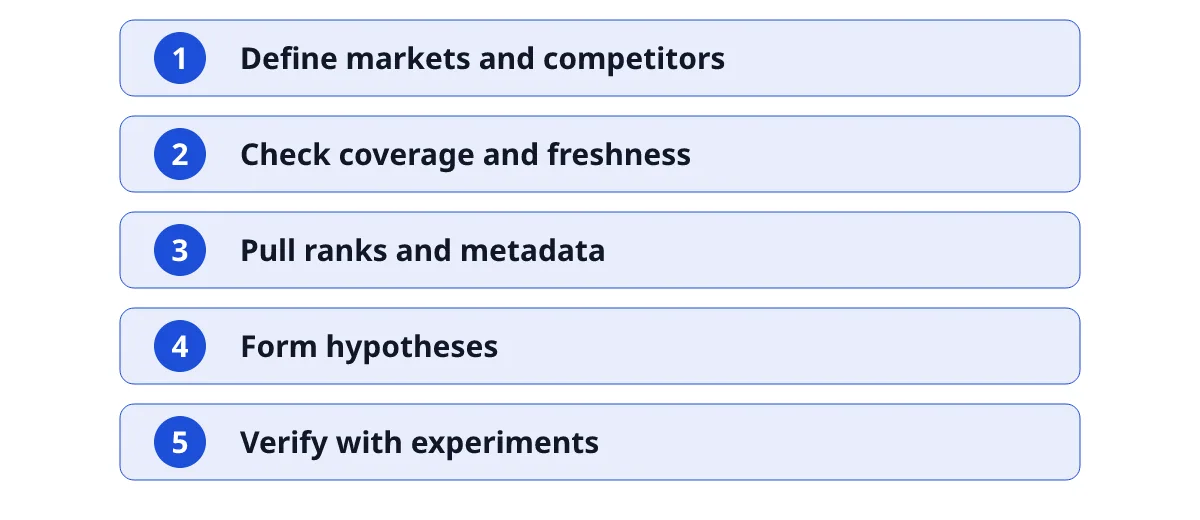
Then work through these steps:
- Fix your storefronts and rivals, so every comparison stays in one scope.
- Pull ranks and metadata first. Treat any strategic verdict as the vendor's own assessment.
- Turn observations into hypotheses. LiteASO's features page describes the aim as to turn observations into hypotheses to verify with supported store experiments.
- Draft and check changes. The same site describes creating, editing, previewing and diagnosing drafts against published platform limits.
Both LiteASO descriptions are attributed public wording, not verified product behavior. For the metadata step, title and subtitle optimization covers the field-level choices.
FAQ
What does an app store competitor analysis API return?
It can return competitor discovery and comparison data. One endpoint finds an app's competitors from store "similar apps" plus apps ranking for the same keywords. Another returns keyword overlap analysis, gap opportunities, and a strategic verdict.
What does an ASO keyword ranking API return?
Typically dated positions per phrase. One example returns a day and a position for each phrase, where a position can be null, and another offers daily keyword rankings. See the ASO audit checklist for using them in a review.
Is popularity the same as search volume?
No. One provider says neither its demand value nor its estimate tier is a search count.
Sources
- Get competitor ASO intelligence | PeekPanda Docs
- App store tools reference: Manifold MCP docs
- AsoBeast Competitors API — OpenAPI & Docs | APIs.io
- REST API · aso.best
- App Store Data API: Keywords, Rankings & Competitors | Ridly
- Competitor ASO Report - Appeeky REST API & MCP Server
- List competitors - AppGoat Docs
- liteaso.com
- competitor-analysis — asoscan/aso-skills
- liteaso.com
- Request competitor data | PeekPanda Docs
- How to find app competitors on Google Play and App Store? – DataForSEO